


Alignment of wind turbines
Easy-Laser has for many years been a leading supplier of measurement and alignment systems for the wind power industry, covering both shaft and coupling alignment as well as flatness measurement of tower flanges. Customers include several of the world’s largest wind turbine manufacturers, such as Vestas, Siemens Gamesa, Envision, and Goldwind.
Alignment of generator and gearbox
Standard shaft alignment systems or specially adapted OEM variants are used for aligning the generator and gearbox. The OEM variants are designed to match a turbine manufacturer’s specific coupling dimensions across multiple turbine models. These systems are intended for use with the coupling removed and the rotor locked, which provides the safest working conditions for the operator.
Easy-Laser’s standard systems are used for other coupling designs and in situations where it is considered safe to keep the coupling in place. They are suitable for both installation and ongoing maintenance in the field, making them well adapted to the needs of service companies.
Learn more about our shaft alignment systems for wind turbines.
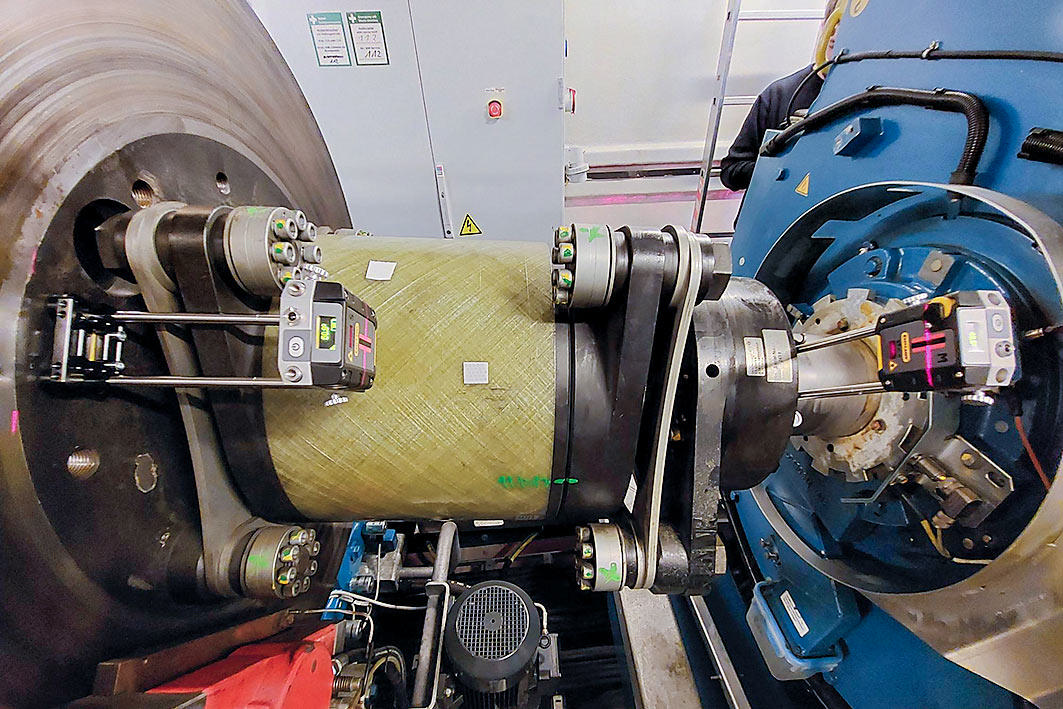
Generator to gearbox alignment using an XT shaft alignment system.
Flatness measurement of tower flanges
The difficulty of measuring flange flatness depends partly on the tower diameter. Smaller diameters, up to around four meters, are usually straightforward to measure. But large diameters, especially large offshore towers, require a different approach.
Our patented sectional measurement software is ideal to use in this case. With this method, the flange is measured as four sections, which are then mathematically combined for a complete result. There are two main advantages to this: the measurement is not affected by the flange being deformed by its own weight (gravitational impact). It also makes the work safer for the technician, who does not have to stand on a high ladder or platform – all measurement are carried out from ground level.
Flatness measurement of flanges on blades and blade hubs
The flanges on turbine blades and at the blade-to-hub interface also need to be flat to ensure correct assembly and load distribution. These surfaces are checked using the same type of measurement equipment as for tower flanges.