


Align right from the start – optimize production
In manufacturing, machines are expected to deliver high product quality – often at high speed. This depends on correct installation and precise alignment. Easy-Laser measurement systems help ensure machines are positioned as intended and perform according to specification.
Reliable installation of production lines
Correct geometry starts with the foundation. Machines must be installed on level, flat surfaces, and bases must be dimensioned correctly. When these basics are in place, machine performance becomes predictable and reliable.
This is especially important when production lines are moved from test build to final installation.
A common scenario is that the production line is designed and test-built in one place, then purchased by an end customer or a packager who built a process skid including many other components. Before delivery, a FAT (Factory Approval Testing) is performed. To prepare the skid for shipping, machine trains are uncoupled, piping is dismantled, and systems are drained of oil and fluids. The skid is then transported to the end customer’s facility, where it is installed and commissioned.
Consider this:
- Skids must be levelled, and flatness must be verified before machines are installed.
- After lifting a skid for transportation, always assume that conditions have changed.
- Final installation at the end customer’s facility should always be treated as a new build.
With this in mind, it becomes clear that precision alignment checks are required at many stages to ensure a reliable machinery installation. A general requirement is better than 0,1 mm/m [0.1 thou/inch] relative level/plumb and for flatness. Construction laser equipment rarely provides the accuracy required by today's highly efficient machines.
Read more about reliable machinery installation.
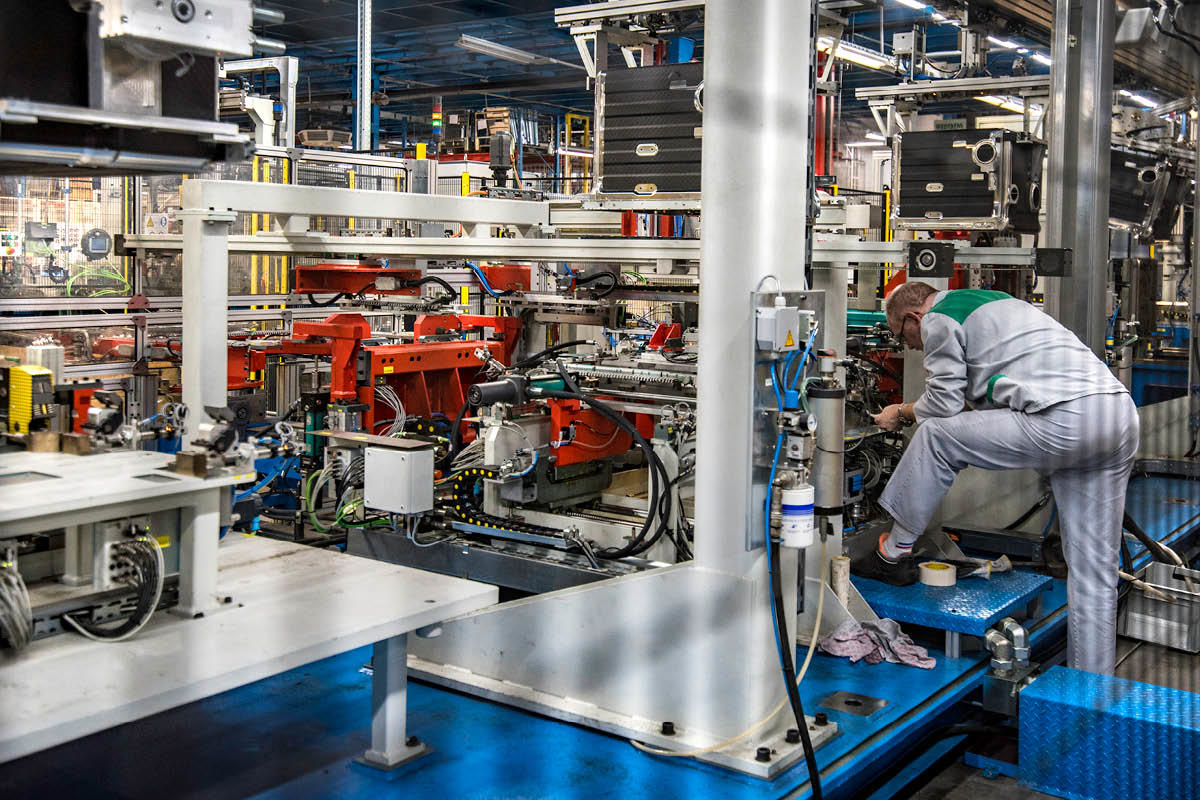
Other manufacturing applications
- Printing presses and cardboard machines
Machines for processing and printing on fine paper and cardboard often require alignment of rolls, cutting heads, and guides. Geometric measurement of machine frames and bases is also common. Using a precision laser system for straightness, flatness, level, and parallelism during machine adjustment typically improves product quality and can increase production speed. - Industrial robots (welding, painting, cutting, material handling)
Industrial robots depend on stable foundations and precise, repeatable movement. Laser systems are used to check foundation flatness to ensure accurate and controllable operation. - Manufacture of diesel engines and gearboxes
In engine and gearbox manufacturing, bore center-line measurements are used to verify the straightness and position of bearing journals and parting surfaces during assembly. See separate page about this. - Manufacture of furniture and furnishings
Machines used in the manufacture of furniture and furnishings, mainly wood but also steel, must be correctly set up and aligned, similar to machines in the metal industry, but not always with the same high demands on precision. - Textile industry
Machines such as automatic looms, knitting machines, and sewing machines include many rolls, guides, and rails that must be straight, flat, parallel, and set at correct angles.