
Unconventional shaft alignment in a water dam
Easy-Laser were called out to help a customer with a measurement and alignment job in a water dam in northern Sweden. We would like to share our experience using our dual detector, dot laser alignment system to get the job done.
Published: February 01, 2019

It is our hope that this application example will inspire you to think in new ways when it comes to alignment. What you perceive as difficult and complicated may in fact, using the right tool, be very easy to do!
A large, well renowned, construction company had won a contract to build a dam with gates to regulate water flow in a hydro power plant project. The dam was placed upstream from a hydro power station. The two gates (or valves) were approximately 8.5 m × 5 m [29x16 feet]. Each valve was specified to allow a leakage of 0.2 liters/minute [0.05 gal/min] in closed position. This meant a very tight seal, and a requirement of high precision alignment on the hinges.
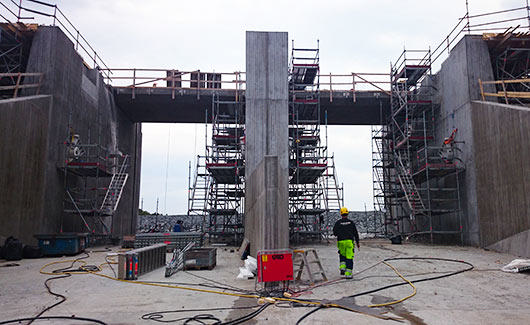
Gate opening.
Traditionally the construction company had been using a total station on a job like this, using it to determine the geometry of the gate construction. There was a problem though, they could not use the total station for the gate hinge alignment. Easy-Laser were contracted to help them with the alignment measurement and to provide training in the shaft alignment system on site for the construction workers.
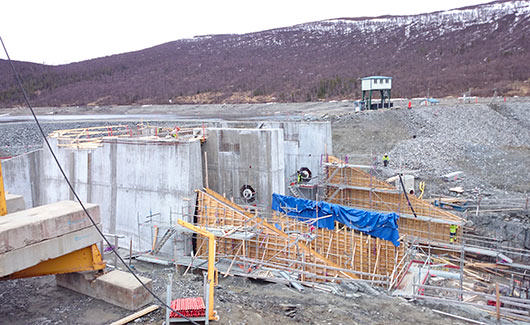
Weather conditions were perfect.
Upon arrival we found two shaft ends pointing at each other. To allow for a good seal these two ends had to be aligned with high precision as the sealing surface is within 10 mm [0.4”] on the sides and 20 mm [0.8”] on the bottom of the gate. To solve this alignment, we had to think of the alignment of these shaft ends as an uncoupled, horizontal shaft alignment.
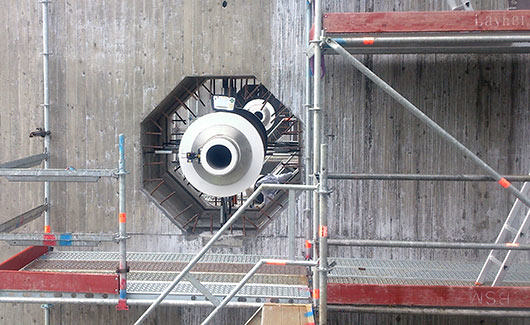
Shaft end (hinge).
We started off with a rough alignment. Using the dual lasers coning technique, finding rotational center, we saved a lot of time.
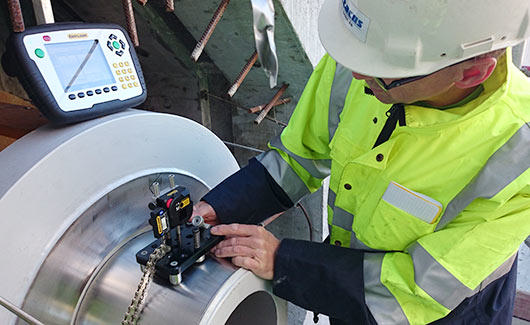
A sliding bracket was used as the shaft end was non-rotatable.
In order to pick which shaft end to designate as the stationary one we used a digital precision level, to check which one was closest to level.
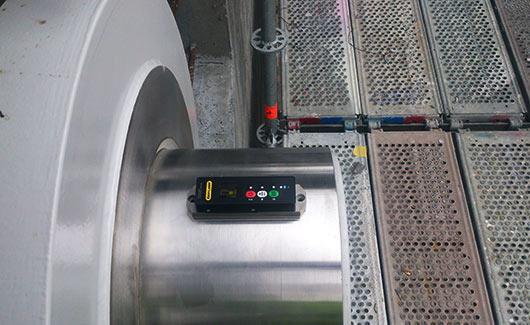
A digital precision level was used to determine which shaft end was closest to level.
The shaft ends were checked for parallelism against the sealing surface using the measuring units in the alignment system and checking straightness over six meters [twenty feet].
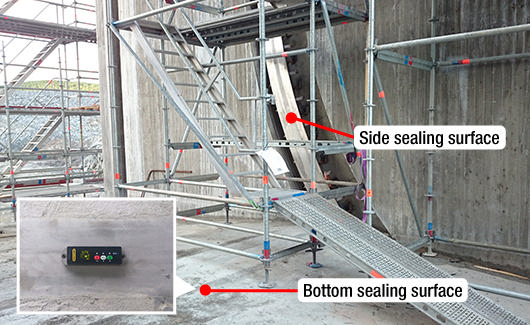
Checking flatness of the sealing surface.
Next, we did a straightness measurement to check parallelism to the sealing surface on the side of the gate.
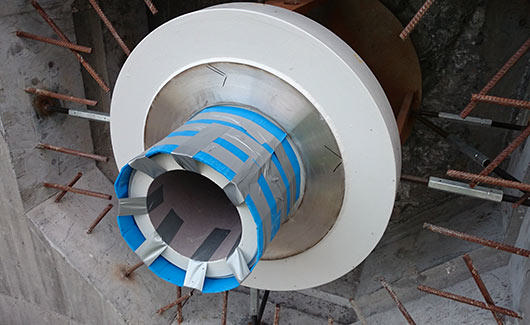
Square marks are used to pinpoint the position of the magnet bases used for the measurement.
Once the shafts had been measured and adjusted the construction crew poured concrete around the shafts to lock them into position. After allowing everything to set for two weeks the gates were mounted without a hinge (pun intended).
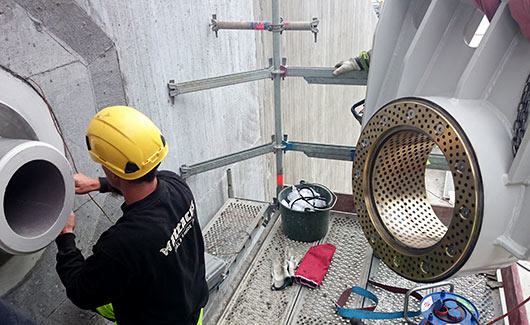
Final preparations before mounting the bearing.
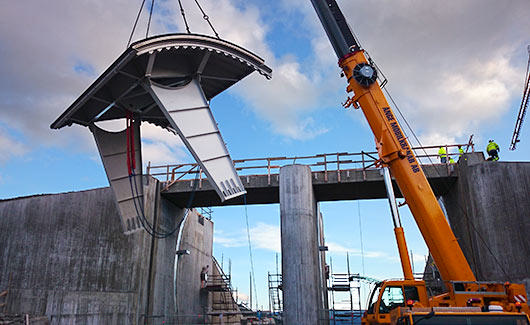
Lifting the gates into place.
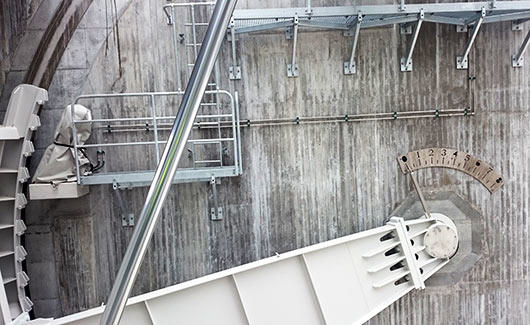
The gates in their final position.
Some time after the job was finalized, we got in touch with the team who installed the gates. They were more than pleased and said they had never had an installation like this run so smoothly!
In this particular case we used the Easy-Laser E710 alignment system, but the XT770 would do the job just as well. A digital precision level such as XT290 comes in handy in all on site installation work, not only shaft alignment. You can, for example, make sure the foundation of a machine is flat to within 0.1 mm/m [0.1 mils/inch] as specified by most manufacturers.
Talk to our experts about how we can help you today
Whether you have a specific application in mind or need guidance, our experts can help you choose the right approach and equipment.
Straightforward advice, aligned with your needs, your operation, and your budget.
Subscribe to our newsletter
Practical alignment knowledge, real industry applications, and product updates – delivered straight to your inbox.